Red Kratom Isn’t a Strain
For years, kratom buyers in Canada and around the world have been told that red kratom is a special, naturally growing strain. Vendors have sold it as something separate from green or white kratom, often at different prices and with different promises.
The truth: red kratom doesn’t grow in the wild. It’s created through a post-harvest process, and the fact that so few vendors tell you this is the real problem.
At Kratom Online, we believe Canadians deserve clear, factual information about the products they buy. That means exposing myths like this one and replacing marketing hype with transparency.
There is only one kratom
Every product on the market, whatever colour or exotic name it carries, comes from the same species: Mitragyna speciosa. The differences aren’t genetic. They don’t come from separate plants growing in separate fields. They come from how the leaves are harvested, dried, and in some cases fermented.
| Misconception | Reality |
|---|
| Red kratom is a different plant | All kratom is Mitragyna speciosa |
| Colour indicates a separate genetic variety | Colour reflects leaf maturity and processing |
| Red comes from red-veined leaves | Red comes from fermentation after harvest |
| “Red strain” is a botanical classification | It’s a vendor naming convention |
What each colour actually is
White kratom comes from younger leaves, dried quickly in low-light or indoor conditions with minimal processing.
Green kratom comes from mature leaves, dried partly in sun and partly in shade, preserving the green tone.
Red kratom is green kratom that has been fermented. There is no red leaf picked from a red tree.
For a fuller breakdown of how drying and oxidation produce each colour, see our guide on what affects kratom leaf colour.
The origin of the “red strain” myth
The myth likely started as a mix of misunderstanding and sales strategy. Vendors know customers look for variety. They label certain batches as a “red strain” and describe them as a naturally occurring, separate type of tree.
The reality is that every kratom tree, whether in West Kalimantan, Thailand or Malaysia, produces leaves that can be processed into red kratom. The colour comes after harvest, not from the tree’s DNA.
Fermentation was adopted historically to darken and preserve mature leaves. As demand grew in Western markets, vendors used the visual difference between red and green as naming shorthand. Over time, “red kratom” became marketing language rather than a botanical fact. By presenting it as a rare strain, vendors could justify higher prices, build brand loyalty, and keep customers in the dark about where products truly came from.
What red kratom actually is
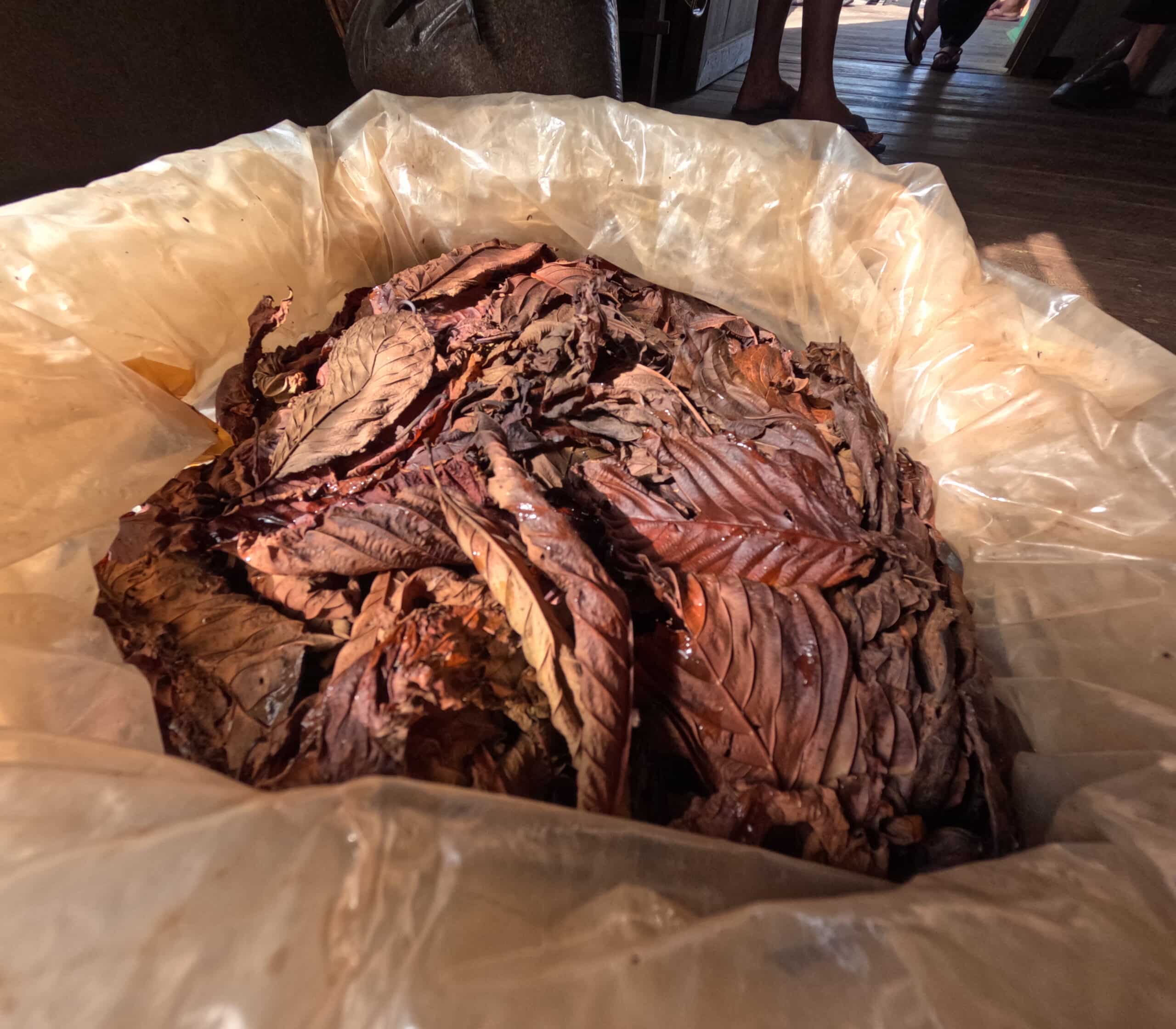
Red kratom is green kratom that has undergone a controlled fermentation process after harvest. Farmers gather mature green-vein leaves, seal them in airtight bags, and leave them in warm, humid conditions to ferment. This natural process darkens the leaf to a reddish-brown and changes its aroma. Fermentation also alters the alkaloid balance, which is why red and green from the same harvest are chemically distinct products.
The basic steps:
Harvesting. Leaves are picked at a chosen maturity stage, often older leaves.
Sorting. Damaged or unsuitable leaves are removed.
Fermentation. Leaves are placed in sealed bags and left in the sun for three to seven days, allowing natural fermentation to occur. A shorter fermentation produces a lighter red. Extend it toward a week and the colour deepens.
Drying. Once fermentation is complete, leaves are dried fully, sometimes in sun, sometimes in shade, before being milled into powder.
The result is a reddish-brown to caramel powder with a distinctive earthy aroma, often compared to ripe fruit or caramel.
Standard red versus Super Red Bali
Not all red kratom is processed the same way. The difference between a standard red and what we sell as Super Red Bali comes down to what happens before and after fermentation.
| | Standard red kratom | Super Red Bali |
|---|
| Leaf selection | Mature leaves, mixed quality | Hand-selected mature leaves |
| Stem and vein | Partially retained | Fully removed before milling |
| Fermentation | Variable or minimal | Controlled 3 to 7 day sealed process |
| Drying | Shade or sun | Shade with controlled airflow |
| Texture | Fibrous, inconsistent | Ultra-fine, smooth, uniform |
| Lab testing | Sometimes unavailable | Every batch |
The “Super” designation refers to the extra step of removing the central vein by hand before drying. It is time-consuming work most producers skip, but it produces a finer, more consistent powder. It does not mean the plant was different.
Why this matters for buyers in Canada
If all kratom comes from the same plant, then the real quality markers are origin, harvesting practices, drying method and freshness, not the name printed on the bag.
Proper fermentation also requires clean, well-managed conditions. Poor handling during the sealed-bag stage is one of the most common sources of microbial contamination in red kratom, which is why batch-specific lab testing matters more for red than for any other colour.
And in Canada, kratom cannot be marketed for ingestion. Responsible vendors focus on origin, processing and lab results, not exaggerated claims about what a colour will do.
The role of honest vendors
At Kratom Online, we refuse to sell you a story just to make a sale. If a product is fermented to become red, we say so. We visit our sourcing regions in Djongkong, West Kalimantan, to document every step from harvest to final packaging.
We know our farmers, we’ve walked through their drying houses, and we’ve seen the exact conditions that produce the kratom we offer. No middlemen, no mystery, no false strain labels.
How to spot truth in kratom marketing
If a vendor claims red kratom grows naturally in the forest, that’s your cue to ask questions. Reliable suppliers will:
- Explain the fermentation process clearly
- State the fermentation period and drying method
- Offer batch-specific Certificates of Analysis covering heavy metals and microbiology
- Give real sourcing details, not vague “from Southeast Asia” statements
- Label products correctly, with no dosage, therapeutic or usage claims
When you understand where your kratom comes from and how it was made, you’re not just a customer. You’re an informed buyer.
Final thoughts
Red kratom isn’t a plant you can pluck off a tree. It’s a traditional, natural processing method that changes the leaf after harvest. The fact that so many vendors have marketed it as a separate strain is a sign of how little transparency exists in the kratom market.
At Kratom Online, we believe in replacing confusion with clarity. That’s why we’re upfront about how our kratom is grown, processed and tested. Because honesty is worth more than any marketing trick.
Want to see how each of our strains is made? Read Behind the Names: How Our Strains Are Actually Made. Or learn more about how we source directly in our Field Report from Djongkong.