Is Kratom Legal in Canada? The 2027 Guide
Kratom’s legal status in Canada confuses a lot of people, and most of the confusion comes from one thing: the answer is genuinely two answers at once. This guide covers the federal framework, what Health Canada has actually done about it, what changes are coming from the United States, and how to stay on the right side of the line heading into 2027.
1. The federal position
Kratom is not a controlled substance in Canada. Mitragyna speciosa and its alkaloids are absent from the Controlled Drugs and Substances Act. Possession is legal. Purchase is legal. There is no criminal exposure for having it.
What Health Canada restricts is the sale of kratom for human consumption. The department classifies it as an unauthorized natural health product, meaning no company holds a Natural Product Number for it and none can legally sell it as a food, supplement, medicine or anything intended to be ingested.
In practice that produces three rules for anyone selling it:
- It cannot be labelled, marketed or described for consumption
- No health, therapeutic or effect claims of any kind
- It must be sold as a botanical specimen for research, collection or ethnobotanical purposes
Nothing in this framework has changed in years, and nothing indicates it will change in 2027.
2. What Health Canada has actually done
This is where most guides go vague. The enforcement record is public and specific.
Health Canada issued four kratom advisories, all involving physical seizures from retail stores:
- June 2017: Jupiter and Kratom Zone products seized from two Edmonton stores
- July 2017: multiple products seized from Culture Rising in Milton, Ontario
- January 2018: Yellow Borneo kratom seized from George’s Convenience locations across Brampton, Maple, Markham and Woodbridge, alongside sexual enhancement products
- May 2018: Sāj brand products seized from two Edmonton stores
Every action targeted a physical storefront. Every one occurred in a fourteen-month window in 2017 and 2018. There is no documented Health Canada seizure since, and none has ever targeted an online vendor operating within the botanical framework.
The pattern is consistent: enforcement went after retail stores mixing kratom with unrelated unauthorized products, or selling it openly as a consumable. Compliant vendors were not the target then and have not been since.
3. Provincial overview
Kratom regulation is federal. No province has enacted a ban, and no province regulates it independently.
The only provincial rule that matters in practice is Quebec’s Charter of the French Language, which requires French labelling on any product sold in the province. A vendor shipping into Quebec without bilingual packaging is non-compliant regardless of what else they do right.
Beyond that, provincial differences come down to retail presence and delivery time. Ontario has a handful of head shops carrying kratom. Most other provinces are online-only markets in practice. For city-by-city detail, see our guide on where to buy kratom in Canada by region.
Two very different situations get lumped together here, and the difference matters.
Domestic orders from a Canadian vendor do not pass through customs. There is no CBSA involvement, no seizure risk, nothing to declare. The package moves through Canada Post like any other domestic parcel.
Personal imports from the United States or Indonesia are a different matter. CBSA has worked with Health Canada since 2017 to intercept kratom shipments entering the country, and the FDA republished its own import alert on kratom in February 2025. Packages get through sometimes. They get seized sometimes. There is no way to predict which, and no recourse when it happens.
Commercial import for resale requires the importer to handle customs properly, use a licensed broker, and ensure the product is correctly declared. That is how compliant Canadian vendors operate. It is not something a consumer should attempt.
5. What changed in the United States, and why it matters here
Canada’s rules are independent of American ones, but Health Canada watches what the FDA does, and the last eighteen months have been busy.
In July 2025, the FDA issued warning letters to seven companies selling concentrated 7-hydroxymitragynine products and formally recommended Schedule I classification for 7-OH. In July 2026, the DEA moved to act on that recommendation. As of August 26, 2026, three synthetic compounds related to 7-OH are officially Schedule I in the United States, and concentrated 7-OH itself remains under review with a decision expected in 2027.
The critical detail: the DEA action explicitly excludes natural kratom leaf. Whole-leaf products with naturally occurring trace 7-OH are not affected. The target is concentrated extracts and synthetic derivatives.
This matters for Canada in two ways. First, it signals where regulatory concern is concentrated globally: on extracts and enhanced products, not on plain botanical powder. Second, it makes the distinction between leaf and extract sharper than it has ever been. A Canadian vendor selling extracts is now operating in a category that the United States is actively scheduling.
For context, the DEA tried to schedule kratom itself in 2016 and withdrew after more than 23,000 public comments, the first time the agency had ever reversed a scheduling decision. The 2025 and 2026 actions were deliberately narrower.
6. What compliant looks like
The framework above gives a practical test for evaluating any vendor.
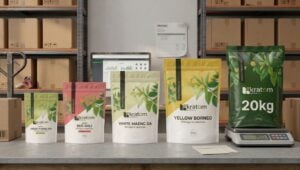
A compliant vendor sells botanical specimens, not consumables. Labels say so. Product descriptions say so. When a customer emails asking which strain is best for a particular purpose, the vendor declines to answer, because answering would cross the line.
A compliant vendor publishes lab results tied to specific batches, from a named accredited laboratory, covering alkaloid content, heavy metals and microbiology.
A compliant vendor accepts e-transfer rather than credit cards, because Visa and Mastercard block kratom transactions across the entire industry and any vendor processing them directly is either misclassifying transactions or about to lose their processor.
A compliant vendor in Quebec labels in French.
And a compliant vendor can tell you where the product comes from. Not “Southeast Asia.” A region, a village, a relationship. Vendors who have visited their source describe it easily. Vendors buying from brokers cannot.
Kratom Online meets each of these. Our kratom comes from farming families in Djongkong, in the Kapuas Hulu region of West Kalimantan, which we have visited in person. Every batch is tested by an accredited Canadian laboratory. Packaging is bilingual.
7. Why kratom has no NPN
A Natural Product Number requires a licence application with safety, efficacy and quality data meeting Health Canada’s standards. No company has submitted one for kratom, and none is likely to.
The reasons are practical. Kratom is a whole plant with dozens of active compounds in proportions that vary by harvest, region and processing. Standardising it to the degree an NPN application demands would require a level of control over a wild-harvested botanical that does not exist. And the commercial incentive is weak: the product is legal to sell in its current category, and the cost of an NPN process would run into the millions with no guarantee of approval.
So it stays where it is. Not banned, not approved, sold as a botanical.
8. Could the rules change?
In Canada, probably not soon. Health Canada has shown no appetite for either scheduling kratom or approving it. The last enforcement action was in 2018. The department’s position has been stable for close to a decade.
Internationally, the direction is mixed. Thailand removed kratom from its narcotics list in 2021, reversing a ban that had stood since 1943. The United States is tightening on extracts while leaving leaf alone. Indonesia, which supplies almost all the world’s kratom, tightened its export documentation in 2025 to require the plant be declared by its botanical name rather than under euphemisms.
If Canada moves, the most likely trigger would be a Canadian version of the American 7-OH concern, targeting concentrated products rather than leaf. Vendors selling extracts would be exposed. Vendors selling plain botanical powder likely would not.
Frequently asked questions
Is kratom legal to buy in Canada in 2027?
Yes. It is not a controlled substance. Possession and purchase are legal. Sale for consumption is not.
Can I get in trouble for having it?
No. There is no criminal law against possessing kratom in Canada.
Can I order from the United States?
You can try. CBSA may seize it. Domestic vendors carry no such risk.
Why do vendors label it “not for human consumption”?
Because that is the legal category the product occupies. It is not a workaround or a loophole. It is the framework Health Canada set, and compliant vendors operate inside it.
Has Health Canada ever gone after an online vendor?
Not in any documented advisory. All four enforcement actions targeted physical retail stores in 2017 and 2018.
Are extracts legal in Canada?
The same framework applies: not banned, not authorized for consumption. But the United States is now actively scheduling concentrated extracts and synthetic derivatives, which makes extracts a more exposed category than plain leaf.
Does the American 7-OH action affect Canada?
Not directly. But it shows where regulators are focused, and Health Canada tends to follow FDA direction over time.
Conclusion
Kratom in Canada heading into 2027 sits exactly where it has for years: legal to possess, legal to buy, restricted to sell for consumption, and unregulated at the provincial level beyond Quebec’s language requirements.
The framework is clear enough that compliance is straightforward. Vendors who label correctly, test their product, decline to make claims, and can explain their sourcing are operating the way the rules require. The enforcement record backs that up.
If you are buying, the practical advice is simple: choose a vendor that meets those standards. If you are selling, meet them.