Kratom in Canada: Strain Guide for Buyers (2027)
Overview and legal reminder
Kratom is legal to possess and import in Canada, but it is considered an unauthorized natural health product. That means it cannot be marketed for ingestion or therapeutic effects. All products must be labelled as “not for human consumption” or “botanical specimen.”
These rules apply nationwide. With no approved Natural Product Number for kratom, it can be imported and sold commercially, but only as a botanical specimen for research, collection and ethnobotanical purposes.
This guide walks through our strain categories, green, red, white, gold and yellow, plus Super Strains, so you can understand the differences between them.
Green vein strains
Green vein kratom is harvested at mid-maturity. Leaves stay green and undergo shade drying to preserve colour and texture.
- Named for a drying style, not a Malaysian origin. Our batches come from West Kalimantan, Indonesia.
- Leaves harvested at full green maturity, dried slowly in shade over several days, then milled into fine powder.
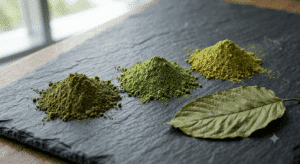
- Deep green to olive colour, mild leafy and earth-fresh aroma.
- No fermentation, no vein removal.
- Premium green prepared by removing the central stem and vein by hand before drying.
- Ultra-fine texture with minimal fibrous content, our most consistent powder.
- Bright, uniform green with a clean grassy aroma.
- Our best seller.
Red vein strains
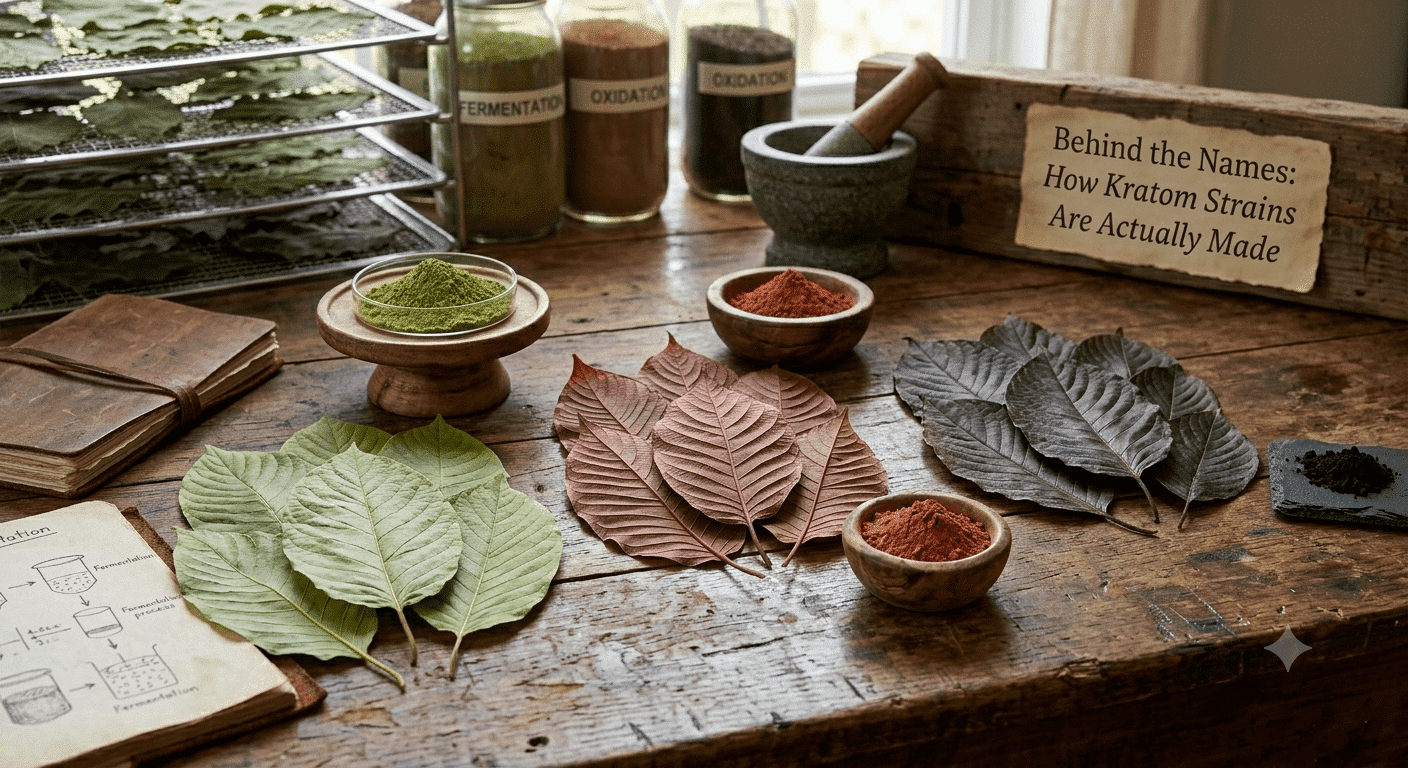
Red vein kratom comes from mature leaves that undergo fermentation before drying. Red is not a different plant. It is green leaf that has been fermented.
- Fully mature red-vein leaves harvested in West Kalimantan.
- Central stem and vein removed by hand, then fermented 3 to 7 days in sealed bags under the sun, then shade-dried.
- Deep red to caramel brown, earthy aroma with notes of ripe banana and cacao.
- Mature red-vein leaves with a shorter fermentation than Red Bali, 3 to 5 days.
- Shade-dried with an optional brief sun finish.
- Softer red running toward rusty brown, milder and smoother aroma with wood and hay notes.
White vein strains
White vein kratom comes from younger leaves and is processed with minimal alteration. No fermentation.
- Early-stage harvest, dried in shade or ventilated indoor spaces in under 48 hours.
- No vein removal, keeping the process close to traditional smallholder production.
- Pale green to soft beige, crisp and neutral aroma.
- Hand-sorted early leaves with partial vein removal for a cleaner grind.
- Sits between standard preparation and our Super Strains.
- Off-white to pale green, light herbal aroma.
Gold and yellow strains
Gold and yellow sit between green and red on the processing spectrum. Both involve a short fermentation followed by sun drying, rather than the long sealed-bag process used for red.
- Fermentation of roughly 24 to 48 hours, then sun drying.
- Warm golden-brown, mildly sweet and floral aroma with dried grass notes.
- Shorter fermentation of roughly 12 to 24 hours, then one to two days of sun drying.
- Lighter golden-beige, gentle aroma with sun-cured and sweet hay notes.
Crushed leaf
- Whole dried leaves broken by hand rather than milled.
- No fermentation, no sorting, no vein removal. The least processed product we carry.
- Green, with visible leaf fragments and a fresh vegetal aroma closer to dried tea leaf.
Comparison table
| Strain | Harvest stage | Processing | Colour | Texture and aroma |
|---|---|---|---|---|
| Green Malay | Mid-mature | Slow shade drying | Deep green to olive | Powdery, leafy, vegetal |
| Super Green Maeng Da | Mid-mature | Vein removal, fine milling | Bright green | Ultra-fine, clean and grassy |
| Super Red Bali | Mature | Vein removal, 3 to 7 day fermentation | Red to caramel | Dense, earthy, banana and cacao |
| Red Thai | Mature | 3 to 5 day fermentation | Rusty red to brown | Medium-fine, wood and hay |
| White Borneo | Young leaves | No fermentation, quick shade dry | Pale green to beige | Dry, crisp, clean |
| White Maeng Da | Early stage | Partial vein removal | Off-white to pale green | Fine, lightly herbal |
| Gold Bali | Early to mid | 24 to 48 hour fermentation, sun dry | Golden brown | Smooth, sweet and floral |
| Yellow Borneo | Early to mid | 12 to 24 hour fermentation, sun dry | Golden beige | Sun-cured, straw-like |
| Crushed Leaf | Mature | Dried and broken, not milled | Green | Coarse fragments, fresh vegetal |
What to look for when buying in Canada
Ask for batch-specific Certificates of Analysis. They should cover heavy metals, microbiology, alkaloid content and moisture, from a named accredited laboratory, tied to the lot you are buying. A generic testing claim without a document is not testing you can use.
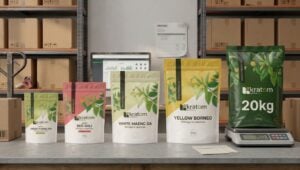
Check the labelling. Packaging must state “not for human consumption” or identify the product as a botanical specimen. In Quebec, labelling must also be in French.
Prefer vendors shipping from within Canada. A domestic order does not pass through customs. Ordering from abroad carries a real seizure risk with no recourse.
Look for a real origin statement. Not “Indonesia” or “Southeast Asia,” but a region. Vendors who source directly can name it. Vendors buying through brokers cannot.
Note that compliant vendors will decline certain questions. If you ask which strain suits a particular purpose and the vendor answers, they are operating outside the framework. Declining is the correct answer, not evasiveness.
Why labelling and transparency matter
Health Canada has taken enforcement action against retailers marketing kratom for therapeutic use. All four documented seizures, between 2017 and 2018, targeted physical stores selling it openly as a consumable or alongside unauthorised supplements.
Vendors operating inside the botanical specimen framework have not been targets. The rules are clear enough that compliance is achievable, and the line is not ambiguous.
Summary
Every product above comes from the same species, Mitragyna speciosa, grown by the same farming families in Djongkong, West Kalimantan. The differences come entirely from when the leaf was picked and what happened to it afterward.
Colour names and strain labels are processing conventions, not botanical classifications. What actually distinguishes one product from another is harvest timing, fermentation length and drying method, and those are the things worth asking any vendor about.
For the full explanation of how colour develops, see Kratom Color Variation. For where our kratom comes from, see our Field Report from Djongkong.