Kratom is drawing more international attention every year, and with it come questions about how it is produced and what that production does to the places it comes from. Those are fair questions. The answer depends entirely on where the kratom is grown and how, and the difference between good and bad sourcing is not subtle.
This is an account of what sustainable kratom production means in practice, based on the region we source from and the families we work with.
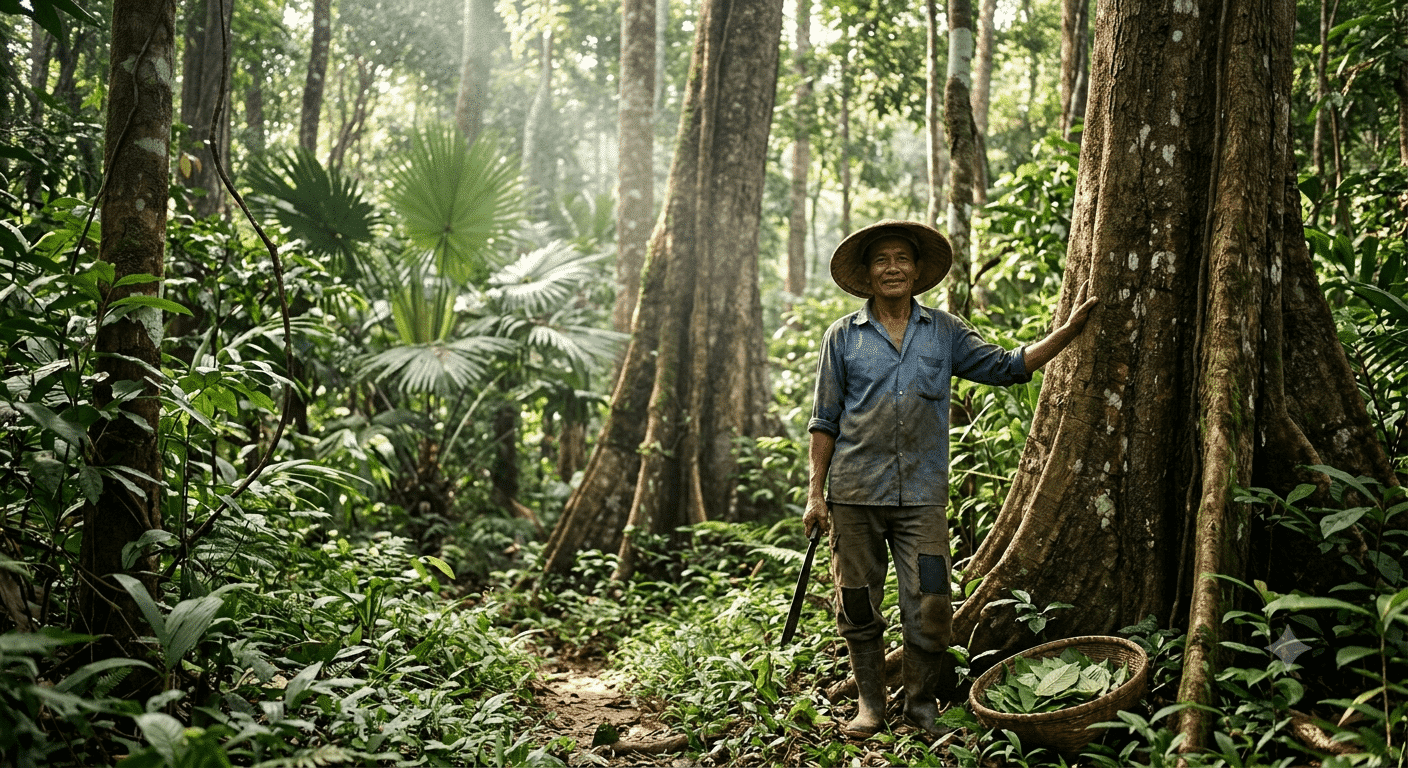
The single most important thing to understand about kratom is that it is a tree that grows in the forest, not a crop that grows in a field.
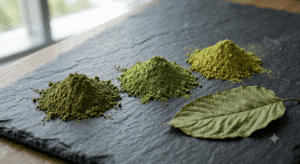
Mitragyna speciosa is a tropical evergreen in the coffee family, reaching twenty-five metres in maturity. It grows naturally along rivers and in seasonally flooded lowlands across Borneo, the Malay peninsula and mainland Southeast Asia. It reseeds itself: a single dried fruit holds roughly five hundred seeds, and where the climate suits it, the tree spreads on its own.
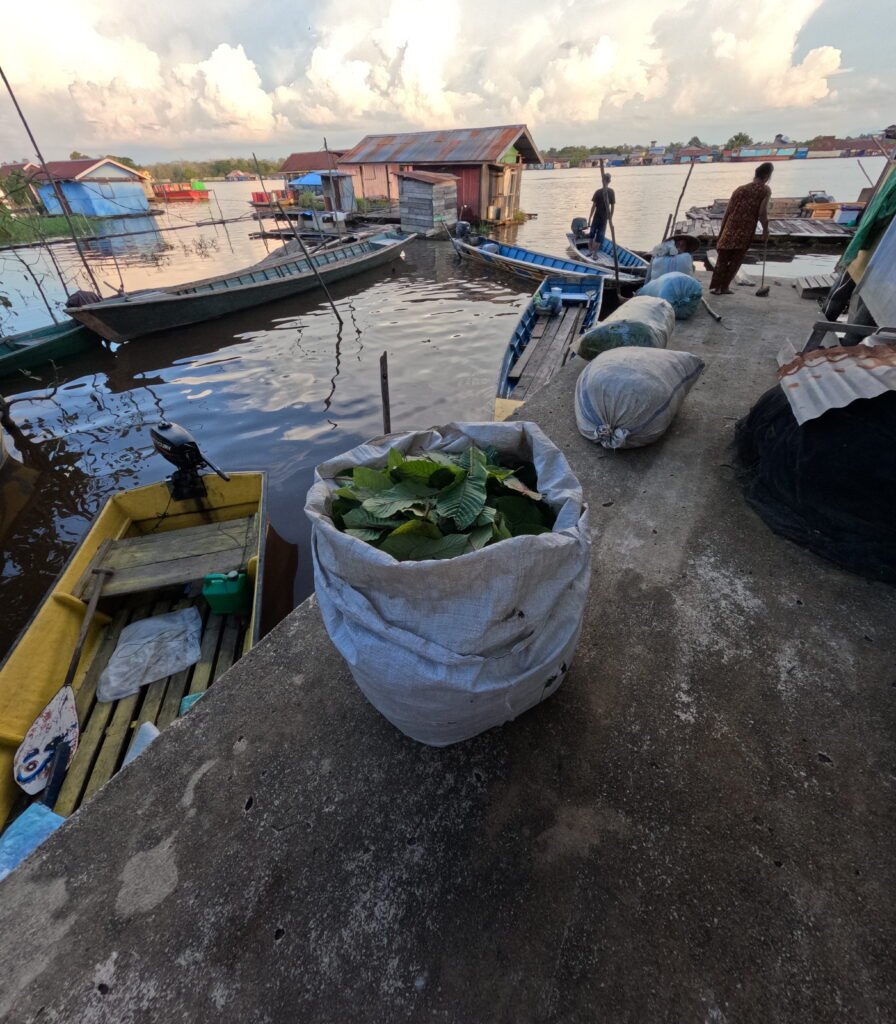
In Djongkong, the village on the Kapuas River where our kratom comes from, the trees are not planted in rows. They grow along the riverbank, between the wooden walkways, beside the stilts of houses. They are harvested by leaf, not felled. A tree picked today will be picked again in a few weeks, and will keep producing for decades.
That is fundamentally different from an agricultural commodity that requires cleared land, tilled soil, irrigation and inputs. Kratom, grown the way it grows in Kapuas Hulu, requires none of those things.
Kapuas Hulu is not an ordinary agricultural district. It was declared a Conservation Regency by Indonesia in 2003 and designated a UNESCO Biosphere Reserve in 2018. Roughly 65 percent of its territory remains under forest cover.
Two national parks anchor the region. Betung Kerihun covers 8,000 square kilometres along the Malaysian border and sits on UNESCO’s World Heritage tentative list. Danau Sentarum is a system of seasonal lakes and flooded forest, where the boundary between woodland and wetland disappears for months at a time. A forest corridor called Labian-Leboyan connects the two.
That corridor is one of the last remaining habitats of the Bornean orangutan. A 2017 survey estimated around 680 orangutans surviving in Danau Sentarum and the corridor combined. The parks also shelter the false gavial, a critically endangered freshwater crocodile, along with more than 500 vascular plant species, 240 species of fish and 237 species of bird.
Kratom grows in the buffer zones around these protected areas, in the riverside villages where families have lived alongside it for generations. It is part of the landscape, not an intrusion on it.
Much of the language used around kratom sourcing is borrowed from commodity agriculture: plantations, cultivation, yield. That vocabulary describes a model where land is cleared, a single crop is planted, and the ecosystem that was there before is replaced.
Kratom in Kapuas Hulu is not produced that way, and the distinction is the whole point. A plantation model would mean clearing forest to plant trees, which would destroy the very conditions that make the region worth sourcing from. The wild-harvest model means the forest stays, the trees stay, and the families who harvest have every reason to keep it that way.
When a vendor describes kratom “plantations,” it is worth asking what they actually mean and whether they have seen one.
Sustainability for a plantation crop means minimising damage. Sustainability for a wild-harvested tree means not disrupting what is already working. In practice, that involves a short list of things that are done, and a longer list of things that are not.
Harvest by leaf. Trees are never cut. Leaves are picked by hand, selectively, by maturity. The tree recovers and produces again within weeks.
No inputs. No fertiliser, because seasonal flooding deposits fresh sediment along the riverbank every year. No pesticides, because the ecosystem is intact enough to manage its own pests. When caterpillars eat young shoots in certain seasons, harvesters pick older leaves instead and wait.
No clearing. The trees grow where they grow. Nobody removes surrounding vegetation to make room for them.
Riverbank integrity. The trees are part of the riparian zone, the strip of vegetation that holds riverbanks together and filters what enters the water. Leaving them in place protects the river the community drinks from and fishes in.
Natural regeneration. Replanting, where it happens at all, means crushing dried fruit by hand and scattering seed near the water. The climate handles the rest.
The absence of intervention is not laziness. It is the method.
The forests of Kapuas Hulu face genuine pressure. The documented threats to the national parks are illegal logging, poaching and the wildlife trade. Across Borneo more broadly, oil palm expansion andmining have converted enormous areas of forest to monoculture and open pit.
Kratom is not among those threats. It does not require clearing. It grows in the riparian buffer zones that conservation planners want preserved. And, crucially, it gives families along the river a reliable income from the forest as it stands.
That last point is the one conservation economists focus on. Communities with no income from intact forest face constant pressure to convert it to something that pays. Communities with income from the forest have a reason to defend it. A kratom tree along the riverbank is worth more standing than cut, year after year. That alignment between livelihood and conservation is rare, and it is one of the strongest arguments for sourcing from this region rather than from industrial operations elsewhere.
Climate change is affecting Borneo as it is affecting everywhere. In Kapuas Hulu, the visible effect is rainfall that has become less predictable. Wet seasons arrive early or late. Dry spells stretch longer than they used to. Flooding, which the river ecosystem depends on, has become more erratic.
For the trees, this has not yet been a crisis. Kratom is adapted to variability, and the river continues to feed it. For the harvest process, it has meant adjustment. Sun drying, the traditional method, depends on reliable clear weather. When that reliability goes, drying takes longer or fails. Producers in Djongkong have responded by building greenhouse drying sheds: enclosed, ventilated structures that let leaves dry on tiered shelves protected from rain, with airflow managed through the building. The result is indistinguishable from sun-dried leaf, but it does not depend on the weather cooperating.
That is adaptation at the scale that matters, by the people who live with the consequences.
We work with a small number of families through one supplier, Fariz Adha, who grew up in the region. There are no brokers, aggregators or anonymous exporters between the harvest and us.
That matters for sustainability in a concrete way. A broker buying from dozens of villages at the lowest available price has no incentive to care how any one of them harvests. A buyer who knows the family, has slept on their floor and eaten at their table, does. Pricing is set by the producers, not imposed on them. Money stays in the community: in the school, in the households, in the continuation of the practices that keep the forest and the harvest going.
We have been there. We have walked the riverbank, watched the harvest, seen the drying and the milling. That is documented in our Field Report from Djongkong.
Every batch we sell can be traced to a specific village and harvest period. That traceability serves two purposes.
It lets us verify what we are told. If a batch tests differently from the last one, we can ask why and get an answer from someone who was there.
And it keeps everyone accountable. A producer whose name is attached to a batch has a reason to maintain standards that an anonymous supplier does not.
Every batch is also tested by an accredited Canadian laboratory for alkaloid content, heavy metals, microbiology and moisture. The lab confirms what the sourcing relationship is designed to produce.
The future of kratom depends on a balance between the plant, the people who harvest it, and the places where it grows. Industrial-scale production would break that balance. It would require clearing, inputs and the kind of extractive relationship that has damaged so many other tropical commodities.
The alternative is what already exists in Kapuas Hulu: forest that stays forest, trees that stay standing, families who benefit from both, and buyers who understand what they are paying for.
We are proud to support that model, and we intend to keep doing so.

Explore our premium Kratom products, carefully selected for quality and purity.

Discover Everything You Need to Know About the Best Kratom in Canada.

You can reach us directly by email or through the contact form above.

Enjoy free shipping on all your orders, with no minimum purchase required.