
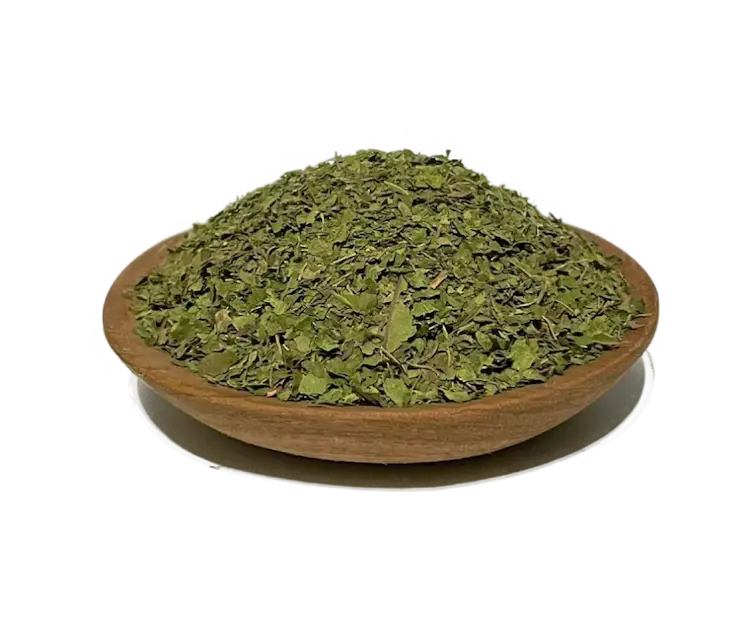
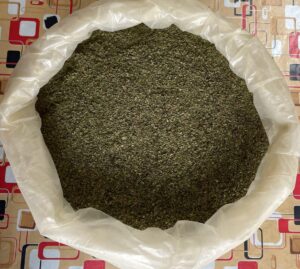
Our Crushed Leaf Kratom is the plant in its simplest form. Whole leaves, dried, then broken by hand into coarse fragments. Nothing removed, nothing sorted, nothing milled.
Unlike our powders, this product carries no strain or colour name, and that is deliberate. All kratom comes from one species, Mitragyna speciosa. The green, white and red categories describe what happened to the leaf after harvest, not what tree it came from. Crushed leaf skips that step entirely, which makes it the closest thing to the plant as it grows along the Kapuas River.
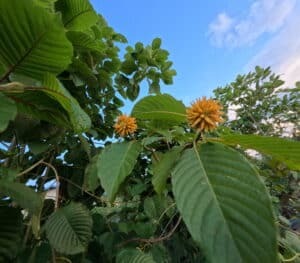
It is made from mature leaves, harvested by hand in Jongkong, West Kalimantan, and dried in shade or ventilated sheds. Because the leaf is broken rather than ground, it retains visible structure: fragments of blade, sections of vein, the texture of the original leaf. The colour is green, matching the dried whole leaf, and the aroma is fresh and vegetal, closer to dried tea leaf than to milled powder.
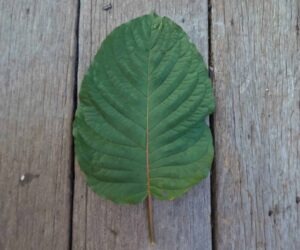
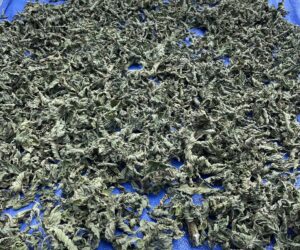
This is also the least handled product we carry. No fermentation, no milling, no vein removal. The leaf goes from tree to drying rack to pouch with the fewest possible steps in between, which is why our lab results on crushed leaf consistently show the cleanest microbiology of any product in the range.
Features
All of our kratom powders come from Indonesia, specifically West Kalimantan province on the island of Borneo, one of the most important kratom-producing regions in the world.
More precisely, our products come from rural farming communities around Jongkong, Putussibau and Kapuas Hulu, where Mitragyna speciosa grows natively in humid lowland forest along the Kapuas River, the longest river in Indonesia.
Why this region
Protected status. Kapuas Hulu was declared a Conservation Regency by Indonesia in 2003 and designated a UNESCO Biosphere Reserve in 2018. Roughly 65 percent of the district remains under forest cover, and it holds two national parks, Betung Kerihun and Danau Sentarum.
Ideal natural conditions. A humid equatorial climate, regular rainfall, and fertile alluvial soil enriched by seasonal flooding. The river deposits fresh sediment each year, which is why the trees grow without fertiliser.
Generational knowledge. Farming families here have worked with kratom for decades, using post-harvest methods refined through repetition rather than instruction. Harvest timing, fermentation duration and drying technique are judged by eye and by smell.
Non-industrial environment. No mining, no factories, no commercial agriculture at scale. Most kratom is harvested in semi-wild or agroforestry settings without chemical inputs. This matters because heavy metal contamination in botanicals is almost always environmental.
We have been there. Our team travelled to Jongkong, stayed with the producing families, and watched the harvest, drying and milling firsthand. That is the difference between naming a region and knowing it.
Understanding names like Bali, Malay or Maeng Da
While our kratom originates in Indonesia, you will see names like Bali, Malay and Maeng Da across our catalogue. These do not refer to where the leaves grew. They refer to:
For example:
Maeng Da indicates leaves that were more carefully selected and more finely processed, not leaves from a Maeng Da tree.
Bali suggests a traditional, balanced drying process, not that the leaf grew on the island of Bali.
Malay describes a mid-green style with extended shade drying, not a harvest in Malaysia.
Every product in our catalogue comes from the same species and the same region. The differences are entirely in what happened after the leaf was picked.
All batches are handled by partner farmers and producers we know by name. The leaves are:
That second test is the one that matters. An export certificate is issued by a lab working for the seller. A Canadian test is commissioned by the party who has to answer for what is in the bag.
Many Canadian vendors name West Kalimantan as their origin, and most of them are buying through brokers who aggregate from farms nobody has visited. Naming a region costs nothing. What is worth asking any vendor is which village, which families, and whether anyone on their end has ever been there.
We can answer all three.
1. Where does this kratom come from?
All our kratom is sourced from small-scale farms in West Kalimantan, Indonesia, particularly the Jongkong region along the Kapuas River. Our team has visited these farms in person.
2. What does “Maeng Da” / “Bali” / “Malay” mean?
These are traditional names referring to post-harvest processing styles or regional naming conventions, not botanical strains or fixed locations. Every product comes from the same species, Mitragyna speciosa.
3. What’s the difference between red, green, white, and gold kratom?
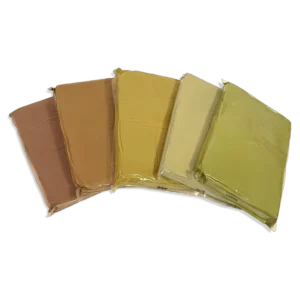
The colours reflect the maturity of the leaf at harvest and the post-harvest processing method. White comes from younger leaves dried quickly, green from mid-stage leaves, and red from mature leaves that have been fermented. Gold and yellow sit between the two, with lighter fermentation or extended sun exposure.
4. What does “Super Strain” mean?
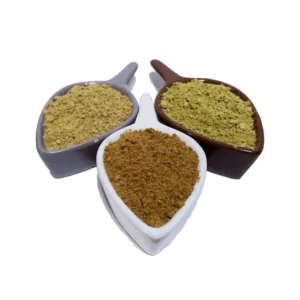
Super Strains are made from carefully selected leaves with the central stem and vein removed by hand before drying. This produces an ultra-fine, uniform powder with minimal fibrous content. Since the vein is largely structural material, removing it also slightly increases alkaloid density, though the difference is marginal.
5. Is this kratom lab-tested?
Yes. Every batch is tested by an accredited Canadian laboratory for alkaloid content, heavy metals, microbiology and moisture before being made available for sale. Certificates of Analysis are batch-specific and available on request.
6. What is this product intended for?
This product is sold for reference and botanical purposes only. It is not intended for human consumption.
7. How is the powder processed?
Leaves are harvested by hand, then dried using sun, shade or ventilated indoor drying depending on the product. Red varieties undergo a controlled fermentation in sealed bags before drying. The dried leaf is then milled on site into a fine powder.
8. How should I store this product?
Store sealed, in a cool dry place away from direct sunlight and moisture. Canadian winters bring very dry indoor air while summers can be humid, so a consistent interior spot works best. Kept properly, a sealed pouch holds its quality for a year or more.
9. Why does the colour of the powder vary slightly between batches?
Natural variation in harvest season, drying conditions and leaf maturity causes slight changes in colour and texture. This is normal for an unprocessed agricultural product, and consistency within a batch matters more than the exact shade.
10. Is kratom legal in Canada?
Kratom is legal to possess and sell in Canada. It has no Natural Product Number from Health Canada, meaning it cannot be sold or marketed for human consumption, which is why all our products are labelled as botanical specimens.
11. Do you ship across Canada?
Yes, free shipping on every order with no minimum. Orders paid before 2 PM Eastern ship the same day from Quebec City.

maximus –
not as strong as the powder. easier to drink tho, better taste.
Barbara –
oh wow, that’s for making tea !! love it
Sp –
Finally 🙏
Raymond Ray –
Je ne connaissais pas cette variation ! trés interessant !
grace bleau Bronze Member –
Belle alternative
mae –
I’ve wanted to try this for so long! Thank you for bringing it in
max –
Je prefer la poudre
Ju –
Pour ceux qui n’ont jamais essayé, les feuilles de kratom sont une alternative intéressante pour la rotation et varier pour les approches. c’est une facon differente de l’intégrer, ca permet de structurer les cycle plus facilement. Personnellement pour moi ca marche trés bien. je fais 3 jours poudre, 2 jour thé.