Every week, people searching for kratom in Canada ask the same kind of questions in forums, Reddit threads, and buyer communities: Is this tested? Can I trust this COA? What lab ran it? How do I even read one of these?
Lab testing has become the central conversation in the Canadian kratom market, not because vendors have made it easy to understand, but because buyers are trying to protect themselves in a space with almost no regulatory guardrails. The questions being asked reveal a community that is paying attention, and a market that has not yet caught up to that level of scrutiny.
This article breaks down what Canadians are actually saying about kratom lab testing: the fears, the red flags, the questions that never get straight answers, and what to look for if you want to buy with real confidence.
Kratom occupies a grey zone in Canada. It is not classified as a controlled substance, but Health Canada considers it an unauthorized natural health product, meaning it cannot be legally sold for ingestion or marketed with any therapeutic claims. Vendors operate under a botanical research or specimen framing. There is no regulatory body actively enforcing quality standards.
That absence of oversight places the entire burden of quality verification on the consumer. In the United States, the American Kratom Association (AKA) runs a voluntary Good Manufacturing Practice program that some vendors pursue, creating at least an informal benchmark. In Canada, there is no equivalent. No certification body. No industry-wide standard.
So Canadian buyers have developed their own checklist, mostly borrowed from American kratom communities and adapted to a market where very few vendors are transparent about what they test, how often, or through whom.
The result is a buyer base that is increasingly educated, increasingly skeptical, and increasingly vocal about what they expect.
Ask anyone active in kratom buyer communities what their first concern is, and you will hear the same answer: fake or recycled Certificates of Analysis.
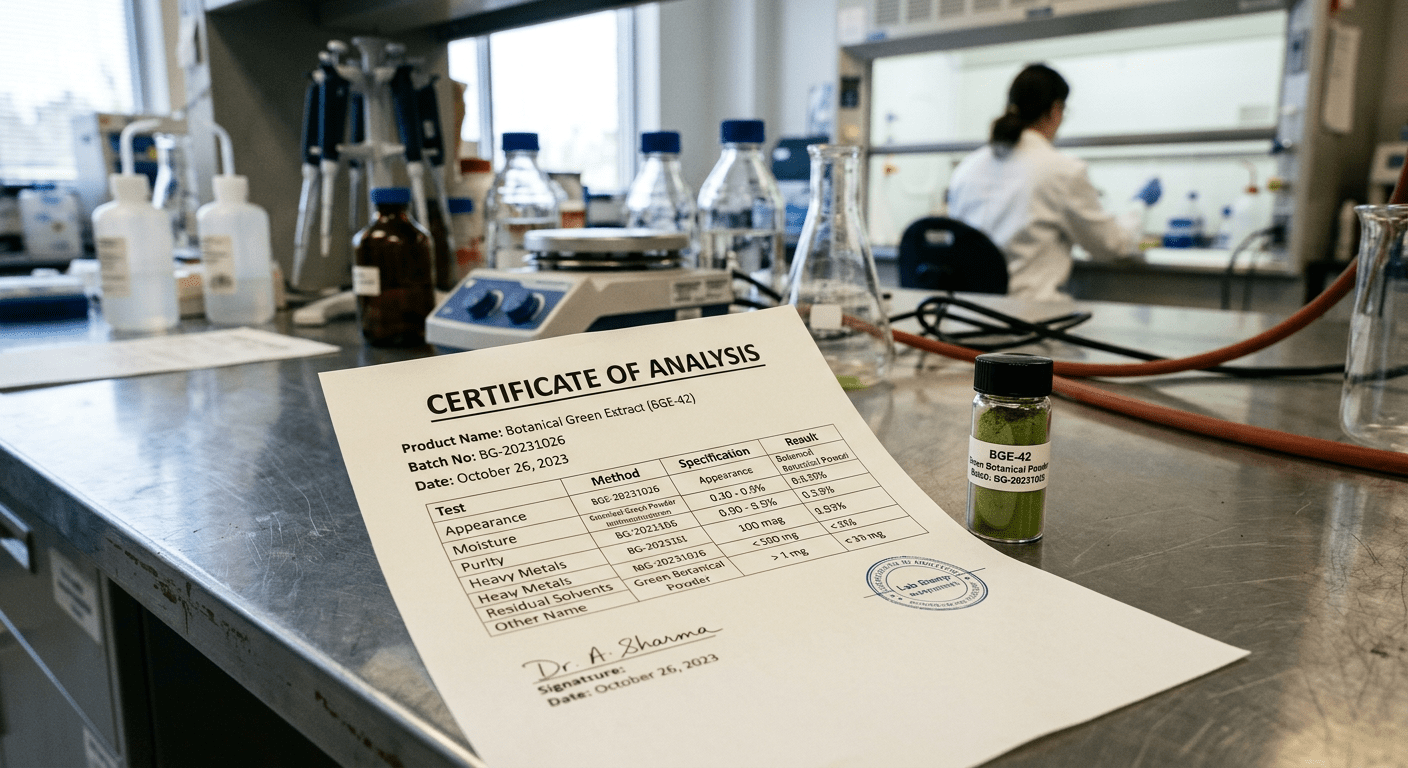
A COA is the document a vendor provides to prove their product has been independently tested. It lists what the lab found, alkaloid levels, contaminant results, microbiological data, and it is supposed to be tied to a specific batch. The problem is that some vendors treat COAs as marketing materials rather than accountability documents. A PDF gets uploaded once and reused indefinitely. The batch number on the certificate does not match the product you receive. Or the lab listed is not genuinely independent from the vendor.
Experienced buyers know to look for specific things. The COA should reference a batch or lot number that matches the packaging you received. Results should be dated within the last twelve to twenty-four months at most, and ideally specific to each batch, not just a generic annual test. The testing laboratory should be identified by name, should be genuinely third-party, and should carry ISO/IEC 17025 accreditation, which is the internationally recognized standard for analytical testing and calibration laboratories.
When a vendor cannot produce a COA that matches those criteria, the community notices. Reddit threads move fast when a vendor gets called out for using outdated documentation or paperwork that cannot be traced to a real accredited facility.
For Canadian buyers, this concern is compounded by the fact that few Canadian vendors name their labs at all. If a COA simply says “lab tested” without identifying the testing facility, its accreditation status, and the methodology used, it is not a COA worth trusting.
The second most common concern, and in many ways the most serious, is heavy metal contamination.
Kratom (Mitragyna speciosa) is a plant. Like many plants, particularly those grown in mineral-rich tropical soils near river systems, it has a known tendency to absorb heavy metals from its environment. Lead, arsenic, mercury, and cadmium are the four that appear most often in testing conversations, and with good reason: chronic exposure to these metals, even at low levels, causes serious long-term health damage.
In regions like Kalimantan, Indonesia, where most commercial kratom is sourced, there is a real variation in soil quality between farms. Areas near industrial activity, former mining land, or contaminated waterways can produce kratom with elevated metal content that would never be visible to the eye and would survive basic processing. This is not unique to kratom, it is a reality across many agricultural botanicals. But because kratom is consumed in repeated doses by regular users, the accumulation risk is higher than it would be for, say, a decorative plant.
A complete heavy metals panel should test for lead, arsenic, mercury, and cadmium at minimum, with results expressed in parts per million (ppm) or micrograms per gram (the two are equivalent). What counts as acceptable depends on context and intended use, but buyers should always verify that a COA actually runs this panel, not just alkaloid content, and that the lab has used validated methodology such as Inductively Coupled Plasma Mass Spectrometry (ICP-MS), which is the gold standard for detecting trace metals at accurate concentrations.
Many COAs circulating in the Canadian market are alkaloid-only. They will tell you the mitragynine percentage but say nothing about metals. For regular kratom users, that is an incomplete picture.
After heavy metals, the next documented concern is microbial contamination, specifically Salmonella and E. coli.
Kratom is harvested, dried, and ground in open-air environments in tropical Southeast Asia. The conditions are warm, sometimes humid, and involve significant manual handling at every stage. Without proper drying practices and hygiene controls, microbial contamination is not a hypothetical, it is a documented real-world problem. Multiple contamination incidents in the North American kratom market have been traced back to poor post-harvest practices.
A proper microbial panel tests for total aerobic plate count, total yeast and mold count, Salmonella, and E. coli. All of these should appear on a legitimate safety-focused COA. Buyers have learned to interpret results in this section: a result listed as “Absent” or “Not Detected” for pathogens alongside counts that fall within safe ranges is what you want to see. Anything that shows detected Salmonella or E. coli is a hard stop, regardless of how appealing the alkaloid profile looks.
The quality of this testing depends heavily on what happens at the farm and mill level, which is exactly why sourcing practices matter as much as the lab results themselves.
The third major topic in buyer conversations is mitragynine content, and the demand for that number to be disclosed per batch, not just generally referenced.
Mitragynine is the primary active alkaloid in kratom. Most quality kratom powders test somewhere between 1.0% and 2.0% mitragynine by dry weight. In Reddit communities, anything below 1.0% is broadly considered substandard. Products in the 1.4% to 2.0% range are viewed as solid. A result above 1.7% is often cited as premium-tier.
The second alkaloid that gets attention is 7-hydroxymitragynine (7-OH-MIT). Present in much smaller quantities, it is considerably more potent per unit. Some vendor conversations have raised questions about products with unusually elevated 7-OH levels, which can indicate processing manipulation rather than natural variation. A credible COA will disclose both.
What consumers have learned to be skeptical of is vague potency language, words like “high alkaloid content” or “premium grade” in marketing copy without a corresponding batch-specific number to back it up. Stating an exact mitragynine percentage tied to a current batch is a signal of vendor confidence. Hiding it, or referencing it only generically, is a signal of something else.
The picture emerging from Canadian consumer communities is consistent: the majority of kratom vendors operating in this country provide inadequate testing documentation.
Common failures include: COAs that are not batch-specific, labs that are either unnamed or cannot be verified as independent, panels that test only alkaloids while skipping heavy metals and microbials, documentation that is months or years old, and no publicly accessible database where customers can match a batch number to its lab results.
Some vendors do not publish COAs at all, noting only that their products are “lab tested” with nothing to show for it. In a regulated industry, that claim would be meaningless without documentation. In an unregulated one, it is still meaningless, and buyers are increasingly calling it out.
Batch number verification has become the single most cited litmus test in online discussions. If the batch number on a COA does not correspond to the product you received, you cannot assume the documentation applies to your purchase. A vendor running genuine per-batch testing will have that linkage in place.
Here is something less often discussed but increasingly relevant: almost no Canadian kratom vendor has direct knowledge of where or how their product is grown.
Most kratom entering Canada flows through brokers or bulk exporters. The vendor places an order, receives a shipment, and may have a COA from a supplier lab, but has no firsthand understanding of the farming environment, the drying practices, the hygiene conditions at the mill, or the soil quality of the origin region.
Lab results can catch problems that surface at the end of the process. They cannot tell you why those problems occurred, and they cannot tell you what practices are in place to prevent them next time.
There is a meaningful difference between a vendor who tests what arrives at their door and a vendor who has actually stood in the farms where their kratom grows, walked the agroforestry plots, seen the drying conditions, built relationships with the families doing the work.
The latter is genuinely rare. When you find it, it changes what the COA represents. It is no longer just a piece of paper at the end of a chain. It becomes the documented result of practices you can actually trace.
One example of that approach is documented in a sourcing report from Kratom Online, which details direct visits to farming communities in Djongkong, West Kalimantan, including firsthand observation of drying methods, water and soil conditions, and the relationships with smallholder producers who supply the kratom. That kind of on-the-ground accountability is, by any honest measure, not the industry standard. You can read that report here: Field Report: A Journey into Ethical Kratom Sourcing in Djongkong, West Kalimantan.
The farm visit question is not just about ethics. It is about the limits of testing. A lab report tells you what is in a specific batch. People who have been to the source can tell you whether the conditions that produced it are reliable enough to trust the next one.
Given everything consumers are asking, here is the practical checklist that serious buyers now apply before purchasing kratom from any vendor operating in Canada:
The lab must be identified and independent. The testing facility should be named on the COA, should have no commercial relationship with the vendor, and should carry ISO/IEC 17025 accreditation. This is verifiable, legitimate labs can be found on accreditation body registries.
The COA must be batch-specific. The batch or lot number on the document should match the number on your product. If a vendor cannot provide this match, the documentation is not applicable to your purchase.
Heavy metals must be tested. Lead, arsenic, mercury, and cadmium at minimum. Results should be expressed in ppm/mcg/g with the methodology noted. ICP-MS is the method of choice.
Microbial panels must be included. Salmonella, E. coli, total yeast and mold count. Pathogens should read as absent or not detected.
Alkaloid content should be disclosed per batch. Mitragynine percentage should be clearly stated, ideally alongside 7-hydroxymitragynine. Compare results across batches if possible, consistency signals quality control.
Results should be current. A COA dated over two years ago for a product on sale today is not adequate documentation for what you are receiving.
The COA should be accessible without requesting it. Vendors who require customers to ask for documentation are creating friction around something that should be standard. Reputable vendors publish COAs on product pages or maintain a publicly accessible batch database.
The Canadian kratom market is at an inflection point. Consumer awareness is outpacing vendor accountability. The buyers asking the hard questions, about lab names, batch numbers, heavy metal panels, and farm practices, are no longer a niche. They represent the direction the market is moving.
Vendors who have invested in genuine third-party testing, per-batch documentation, and traceable sourcing relationships are positioned to meet that demand. Vendors relying on vague claims and recycled paperwork are not, and buyer communities are increasingly efficient at identifying the difference.
For Canadian consumers, the practical takeaway is this: do not buy kratom without a COA that names its lab, covers heavy metals and microbials alongside alkaloids, and ties to a batch number matching your product. If a vendor cannot provide that, there are vendors who can.
The conversation about lab testing in Canada is not going to get quieter. If anything, it is the beginning of a much larger reckoning about what transparency in this market actually requires, and who is willing to meet that standard.

Explore our premium Kratom products, carefully selected for quality and purity.


Enjoy free shipping on all your orders, with no minimum purchase required.