Kratom: Cultural Origins, Botanical History and Its Place in Global Trade
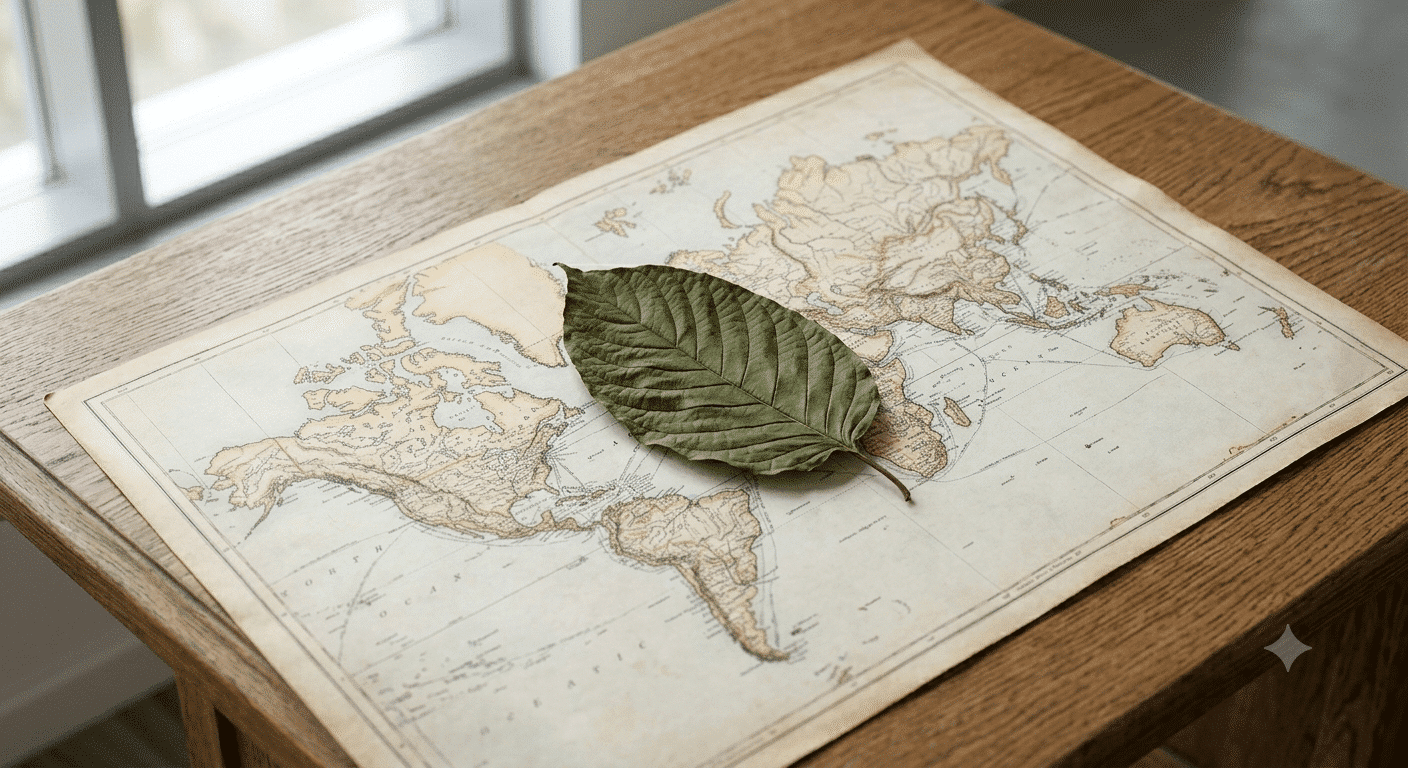
Some plants stay where they started for centuries, then cross the world in a generation. Coffee did it. Tea did it. Ginseng went from the forests of New France to the markets of Canton in the space of two years. Kratom is doing it now.
This is the story of a tree from the river valleys of Southeast Asia, how it came to be documented, regulated, exported and debated, and what that history means for anyone encountering it in Canada.
A member of the coffee family
Mitragyna speciosa belongs to Rubiaceae, the same botanical family as coffee. That relationship surprises most people, but the two plants share a lineage and a habit of producing complex alkaloids. Kratom is a tropical evergreen that can reach twenty-five metres in its native environment, with a straight trunk and smooth grey-green bark spotted with lenticels.
It is native to the humid lowlands of Southeast Asia, growing across what are now Thailand, Malaysia, Indonesia, Myanmar and Papua New Guinea. It thrives below 500 metres elevation, in heat and heavy rainfall, and it does not tolerate frost.
A tree of rivers
Kratom grows where water moves. Its natural habitat is along streams and riverbanks, often in dense groves on floodplains that flood seasonally. The sediment deposited by those floods feeds the trees, and the constant moisture suits them.
This is not incidental to how kratom is sourced today. The Kapuas River in West Kalimantan, the longest river in Indonesia, runs through exactly this kind of terrain. The trees along its banks in the Kapuas Hulu region grow the way they have always grown, in the environment the species evolved for, without irrigation or cultivation in the usual sense. Our own supply comes from Djongkong, a village built on stilts over that river, where kratom grows between the walkways and along the water’s edge.
The Dutch botanist who named it
Kratom entered Western scientific literature through Pieter Willem Korthals, a Dutch botanist attached to the Dutch East India Company’s natural sciences commission. Korthals travelled through the Malay archipelago between 1830 and 1837, cataloguing species that Europeans had never documented.
He formally described the tree in 1839. The genus name he chose, Mitragyna, comes from the shape of the flower’s stigma, which he thought resembled a bishop’s mitre. The species was reclassified several times over the following decades before settling into its current name, Mitragyna speciosa (Korth.) Havil., crediting both Korthals and the botanist George Darby Haviland who finalised the classification.
That Korthals encountered it at all reflects how widespread it already was. The tree was part of the landscape across the region long before any European wrote it down, integrated into rural life and local knowledge systems in ways that oral histories and ethnographic records describe but that no colonial botanist fully captured.
A ban with an economic motive
The first modern regulation of kratom came from Thailand, and its origins are instructive.
The Kratom Act, formally B.E. 2486, took effect in August 1943 and made planting the tree illegal. The timing was wartime, and the government of the day operated a state opium monopoly that generated significant tax revenue. Parliamentary records from the period make the economic reasoning explicit: a freely growing plant that cost nothing was seen as a threat to a taxed state product.
In 1979, Thailand reclassified kratom as a Category V narcotic alongside cannabis. That status held for over four decades. Then in 2021, the Thai government reversed course, removed kratom from the narcotics list, and granted amnesty to more than 12,000 people who had been convicted under the old law.
The lesson is that kratom’s legal status has never been primarily a botanical question. It has been a political and economic one, shaped by what governments were trying to protect or control at particular moments.
Indonesia and the modern supply chain
While Thailand banned it, Indonesia did not. Today Indonesia produces almost all of the kratom traded internationally, and West Kalimantan on the island of Borneo is the centre of that production.
The industry there is small-scale and family-based. Smallholder farmers harvest by hand, dry on tarps in front of their homes, and sell to local aggregators or, in some cases, directly to overseas buyers. The economics are significant for rural communities along the Kapuas, where kratom provides income in areas with few alternatives.
Indonesia has tightened its export framework in recent years. As of 2025, shipments must be declared by their botanical name rather than under euphemisms, and exporters must document lab testing before goods leave the country. That formalisation is part of how the trade is professionalising.
Leaving its region
Kratom’s movement into international markets over the past two decades follows a pattern seen with other botanicals. Tea left China. Coffee left Ethiopia. Turmeric left South Asia. Ginseng, found near Montreal in 1716, was shipped to Canton within two years and remains a major export today.
In each case, a plant embedded in one culture’s landscape and knowledge became an object of curiosity, trade and eventually regulation somewhere else. The receiving markets rarely understood the plant as well as the sending ones. That gap in understanding is where marketing myths form, where quality gets lost, and where regulators step in.
Kratom is at that stage now. It is known by name in dozens of countries, regulated inconsistently, sold under names that range from accurate to invented, and understood far better in Djongkong than in Toronto or Vancouver.
Sustainability and the ethics of demand
Any botanical exported at scale raises questions about how it is grown, harvested and distributed. Kratom is no exception, and the questions are worth asking.
The tree itself is not endangered. It grows readily along rivers, reseeds easily, and is harvested by leaf rather than by felling. But demand creates pressure. Aggregators buying at volume from many farms have less incentive to maintain quality or fair prices than direct relationships do. Communities with few income sources can be pushed toward overharvesting.
The response from responsible parts of the industry has been direct sourcing, fair pricing, and traceability. Knowing which family grew a batch, in which village, along which stretch of river, is the difference between a supply chain and a relationship. It keeps money in the community with the strongest incentive to maintain the forest, and it keeps quality visible.
The Canadian framework
In Canada, kratom is not a controlled substance. It is legal to possess and purchase. But Health Canada has not authorised it as a natural health product, and it cannot be sold or marketed for human consumption.
Compliant vendors operate within that framework by selling kratom as a botanical specimen for research, collection and ethnobotanical purposes. Product descriptions cover origin, processing and testing. They do not cover use.
This constraint has an unexpected benefit. It forces the conversation toward the things that can actually be verified: where the plant came from, how it was processed, what the lab found. Those are the questions that matter for quality anyway.
Ethnobotany as the honest lens
Ethnobotany, the study of how human communities relate to plants, is the discipline that fits kratom best. It asks how a plant is integrated into a culture’s daily life, agricultural practice and knowledge systems, without making that integration universal or prescriptive.
Seen that way, kratom is a tree from the rivers of Borneo and the Malay peninsula, documented by a Dutch botanist in 1839, banned in Thailand for reasons that had little to do with the plant, grown by families in West Kalimantan who have lived alongside it for generations, and now traded around a world that is still working out what to make of it.
That is enough of a story. It does not need marketing on top.
What this means for buyers
Understanding the history changes what questions are worth asking. Not which colour is best, but where the leaf grew. Not what the name means, but what the lab found. Not what the vendor claims, but whether the vendor has been to the source.
The plant has a long history. The least we can do is tell it accurately.