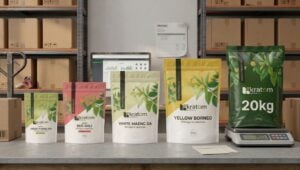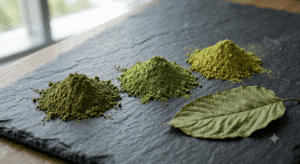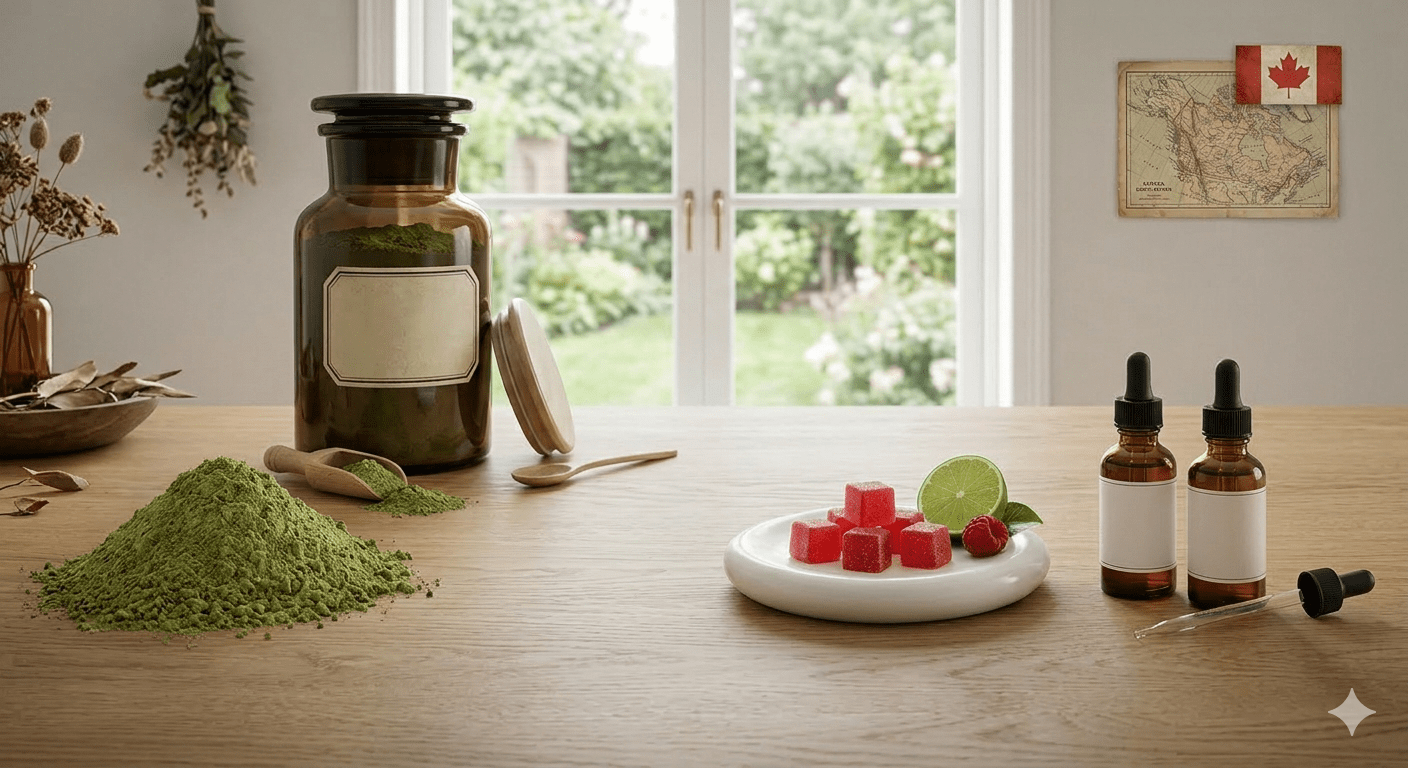
The botanical industry has changed shape in the last three years. For decades, raw leaf in crushed or powdered form was the only format that existed. That is no longer true. Extracts, liquid shots, gummies, pressed tablets and infused products now dominate shelf space in the United States and much of Europe, and the shift shows no sign of slowing.
This is not simply a story about consumer preference. It is about the intersection of product chemistry, regulatory pressure, and a market that is maturing faster than the rules around it. And for anyone buying in Canada, understanding the global picture explains why the domestic market looks the way it does.
The most significant technical development in the category. Where raw leaf contains the full plant matrix, extracts isolate the alkaloids through solvent-based or CO2 extraction, then concentrate them. The result is a product where a few millilitres of liquid contain what would otherwise require many grams of powder.
Extracts are typically labelled by concentration ratio or by alkaloid percentage. A 10x extract means the alkaloid content is ten times that of the starting leaf. Full-spectrum extracts attempt to preserve the plant’s entire alkaloid profile. Isolates target a single compound, most often mitragynine or 7-hydroxymitragynine.
In the United States, extract shots have become one of the highest-volume product categories in the space, sold in small bottles that resemble energy drinks and stocked in convenience stores, smoke shops and gas stations.
Borrowing directly from the CBD and vitamin markets, gummies have grown fastest of any format since 2024. They are produced by infusing an extract into a gelatin or pectin base with added flavouring, resulting in a product visually indistinguishable from ordinary confectionery.
That resemblance is exactly what has drawn regulatory attention. A product that looks like candy, sits on a shelf near candy, and contains a concentrated alkaloid extract raises questions about labelling, child safety and intended use that raw powder never did.
Capsules have been around longer than gummies and remain a stable category. They contain measured quantities of raw powder or extract inside a gelatin or vegetable shell.
Pressed tablets are newer. Instead of a shell, the powder or extract is compressed under pressure into a solid form, sometimes with binding agents. Tablets allow more precise standardisation of contents per unit than capsules, which is part of why they have gained ground in markets where consistency is a selling point.
The most lifestyle-oriented category. Pre-packaged tea sachets or honey sticks containing botanical extracts, often blended with other herbs. These products position themselves around aroma, presentation and ritual, and they tend to be marketed as premium or artisanal.
Understanding these formats means understanding what happens chemically when leaf becomes extract.
Raw kratom leaf contains more than twenty-five distinct alkaloids in proportions that vary by harvest, region and processing. Mitragynine is dominant. 7-hydroxymitragynine, usually written 7-OH, occurs naturally only in trace amounts, typically under 0.05 percent of dry weight.
Extraction changes that picture in two ways.
Concentration. Solvent extraction pulls alkaloids out of the plant matrix and discards the fibre, chlorophyll and inert material. The alkaloid fraction that remains is far more concentrated than it was in the leaf. A finished extract might test at 50 to 60 percent mitragynine, compared to 1 to 2 percent in raw powder.
Residue. Solvent extraction leaves traces of the solvent behind. A properly run Certificate of Analysis for an extract includes a residual solvents panel covering methanol, ethanol, acetone, hexane, toluene and others. Those numbers matter. An extract that passes on alkaloid content but shows elevated methanol is not a clean product.
We have seen extract COAs from Indonesian producers showing mitragynine above 55 percent and total alkaloids above 80 percent, alongside residual methanol above 1,000 ppm. The extraction worked. The cleanup did not.
The format shift collided with regulators in 2025, and the point of collision was 7-hydroxymitragynine.
Natural leaf contains 7-OH only in trace quantities. But some manufacturers began producing extracts with 7-OH deliberately elevated, sometimes to 90 percent or higher, or chemically synthesising it outright. These products were sold as tablets, gummies and shots, often in the same retail channels as ordinary kratom.
In July 2025, the FDA issued warning letters to seven companies marketing concentrated 7-OH products and formally recommended that 7-OH be placed in Schedule I of the Controlled Substances Act. In July 2026, the DEA moved to act on that recommendation. As of August 26, 2026, three synthetic 7-OH derivatives, mitragynine pseudoindoxyl, MGM-15 and MGM-16, are officially Schedule I in the United States. Concentrated 7-OH itself remains under review, with a decision expected in 2027.
The critical detail in the DEA’s action: it explicitly excludes natural kratom leaf. Whole-leaf products with naturally occurring trace 7-OH are not affected. The target is concentrated extracts and synthetic derivatives.
Several US states moved earlier and further. Louisiana banned kratom outright in August 2025. California declared kratom and 7-OH products illegal to sell in October 2025. Tennessee banned 7-OH in July 2026. Rhode Island, which had banned kratom, reversed course and adopted a Kratom Consumer Protection Act in April 2026, the first state to move from prohibition back to regulation.
The pattern is consistent: the regulatory pressure is on concentrates, synthetics and formats that resemble food. Leaf has been left alone.
Canada’s framework predates all of this, and it explains why the formats above are almost entirely absent from Canadian shelves.
Kratom is not scheduled under the Controlled Drugs and Substances Act. Possession is legal. But Health Canada has never issued a Natural Product Number for any kratom product, which means nothing containing it can be sold as a food, supplement or health product. Compliant vendors sell it as a botanical specimen for research, collection and ethnobotanical purposes, with no consumption claims.
That framework has a direct consequence for format. A gummy is a food format. A liquid shot is a beverage format. A capsule implies swallowing. Each of these carries an inherent representation of use that the botanical specimen category cannot accommodate. Raw powder does not carry that representation, which is why it remains the standard here.
Health Canada’s enforcement history bears this out. The four documented kratom seizures, all between 2017 and 2018, targeted retail stores selling products openly as consumables or alongside unauthorised supplements. None targeted botanical powder sold within the specimen framework.
Set aside the regulatory friction and the format shift tells you something useful about where the industry is heading.
Extracts and tablets require standardisation. You cannot sell a product labelled at a specific alkaloid percentage without testing it, and you cannot test it without a laboratory relationship. The rise of these formats has forced parts of the industry toward batch testing, residual solvent analysis and published COAs in a way that raw powder never did.
That is a genuine improvement, and it has raised expectations for leaf products as well. A buyer who has seen an extract COA with a residual solvents panel starts asking why a powder vendor cannot produce a heavy metals panel.
The industry is professionalising. The formats are the visible part of that. The testing infrastructure underneath is the part that matters.
There is a case for raw leaf that has nothing to do with regulation.
Leaf is testable end to end. A COA on raw powder tells you what came out of the ground, what the drying and fermentation did to it, and what contaminants it picked up along the way. There is no extraction step to introduce solvent residue, no concentration step to obscure the original alkaloid ratio, no added flavouring or binding agent to complicate the analysis.
Leaf is traceable. A powder can be tied to a specific harvest, region and processing method. An extract made from pooled material sourced through brokers cannot.
And leaf sits on stable regulatory ground. The DEA’s 2026 action drew a clear line between leaf and concentrate. Health Canada’s framework has accommodated botanical powder for years. Vendors selling leaf are not waiting on a scheduling decision.
That is not a consolation prize. It is the reason the transparent end of the industry has stayed with the plant.
If you encounter extracts, gummies or tablets, whether in Canada or abroad, the questions worth asking are the same ones that apply to any botanical product, with a few additions specific to concentrates.
Full COA including residual solvents. For any extract, the residual solvents panel is as important as the alkaloid panel. Methanol, hexane and toluene should be at or below detection limits.
7-OH concentration stated explicitly. If a product does not disclose its 7-OH content, assume the worst. Natural leaf sits under 0.05 percent. Anything meaningfully above that has been enhanced.
Source material identified. An extract is only as clean as the leaf it came from. If the vendor cannot say where the leaf was grown, the extract inherits that uncertainty.
Format matched to jurisdiction. In Canada, a vendor selling gummies or shots is either unaware of the framework or ignoring it. Neither is a good sign for how they handle everything else.
The global market will keep moving toward extracts and edibles. That is a function of consumer preference and manufacturing scale, and it will not reverse.
Canada will remain a leaf market for the foreseeable future. That is a function of a regulatory framework that has been stable for nearly a decade and shows no sign of changing.
For buyers here, that means the product available is the one that is easiest to test, easiest to trace, and least exposed to the regulatory turbulence now working through the United States. Whether that feels like a limitation or an advantage depends on what you value. If transparency is high on the list, it is an advantage.
Every batch we sell is raw leaf from Djongkong, West Kalimantan, tested by an accredited Canadian laboratory for alkaloid content, heavy metals, microbiology and moisture.
Currently, Health Canada does not recognize kratom as a natural health product or a food ingredient. Because there is no approved framework for human consumption, any product sold in a format clearly intended for eating or drinking (like a gummy or a flavored shot) is prohibited. Vendors must sell botanical specimens in raw forms that do not imply ingestion.
Raw powder is simply the dried and ground leaf of the plant. An extract, however, is a concentrated form where the primary alkaloids have been isolated using a solvent like CO2 or ethanol. This creates a much more potent product, which is why “Extract Shots” are so popular globally, they allow for a smaller volume of material to be used.
In the eyes of Canadian regulators, capsules and pressed tablets occupy a very difficult position. Because a capsule is a delivery system typically used for supplements, it’s often flagged by Health Canada as implying human consumption. This is why many Canadian vendors stick strictly to raw powder to ensure they remain compliant with “non-consumable” marketing laws.
While you may see these products online from U.S. vendors, importing them into Canada is highly risky. Since Health Canada has not approved these formats, Canada Post and CBSA (Customs) frequently seize packages containing gummies, liquids, or extracts. It is generally safer for Canadian residents to source raw botanical specimens from domestic vendors who follow local regulatory guidelines.

Explore our premium Kratom products, carefully selected for quality and purity.


Enjoy free shipping on all your orders, with no minimum purchase required.