Description
Yellow Borneo is a unique kratom variety known for its distinct golden-yellow appearance, achieved not through fermentation but through a specialized drying and oxidation process. Though its name suggests geographic origin, “Borneo” here primarily refers to the traditional Indonesian preparation method, widely practiced in the West Kalimantan region of the island.
What sets Yellow Borneo apart is its color transformation, which occurs naturally when white or green vein leaves are subjected to prolonged sun exposure. Unlike red strains, which undergo fermentation in sealed environments, Yellow Borneo relies solely on oxidation through extended drying in open-air settings, usually under direct or filtered sunlight. This gentle oxidative process gradually shifts the leaf color from green or pale beige to a golden yellow or soft caramel tone, without altering the structure of the leaf itself.
The leaves selected for Yellow Borneo are typically early- to mid-maturity white or green vein leaves, harvested at a point where their physical structure is firm enough to withstand extended drying but still light in alkaloid complexity. These leaves are spread across large drying surfaces, such as bamboo mats, tarps, or suspended mesh racks, and left in the sun for multiple days, often between 3 and 5 days depending on weather and humidity.
This sun-curing method promotes natural oxidation and gives the leaves their distinctive yellow hue. No fermentation is involved, and no artificial agents or flavorings are used. In some cases, a final light shade-drying step is applied to ensure the moisture level is stabilized and the batch remains free from mold or excess humidity.
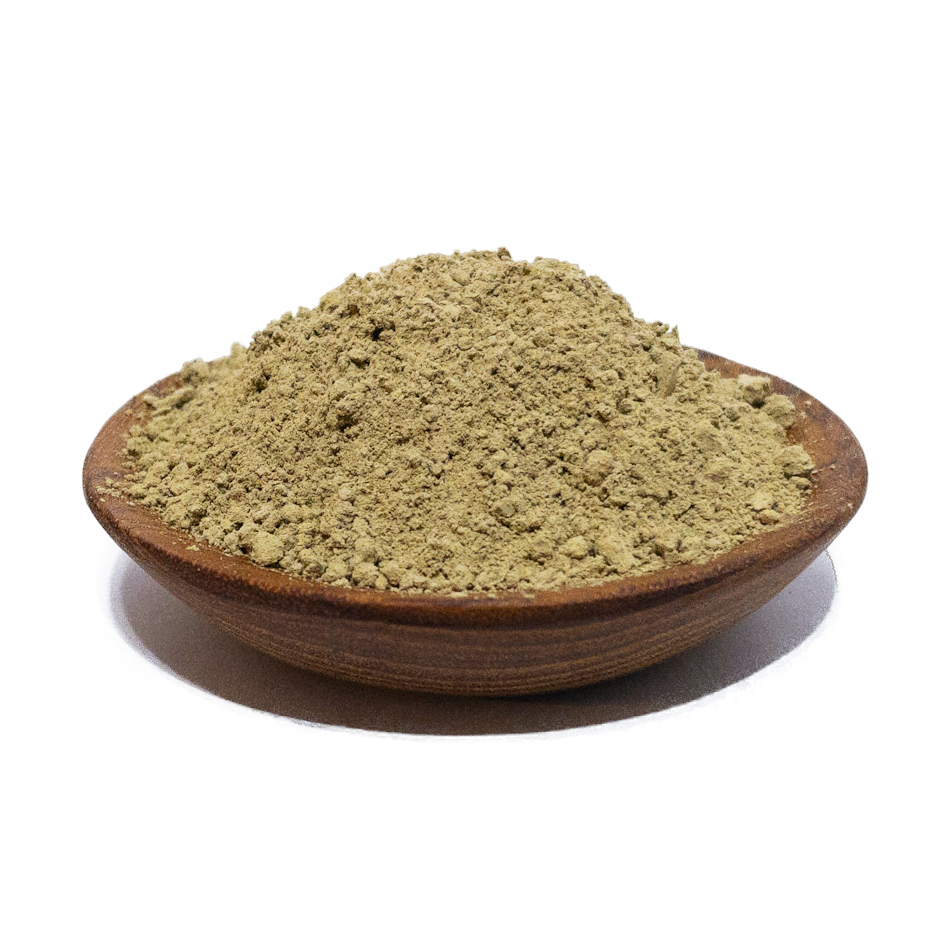
After drying, the leaves are milled into a fine powder, consistent in texture and free from large stems or debris. The resulting product has a soft, golden-beige color and a smooth finish, prized for its purity and consistency in premium kratom powder offerings.
Aromatically, Yellow Borneo tends to offer a gentle and slightly warm scent, with subtle notes of dried grass, sun-cured leaves, and hints of sweet hay. Its lighter, less earthy aroma makes it a notable contrast to red or green strains.
Yellow Borneo is lab-tested for safety, including checks for microbial presence, heavy metals, and overall batch purity. It is prepared using traditional, non-industrial methods, and comes from smallholder farms in regions free from industrial pollution.
Like all kratom products sold in Canada, this strain is labeled for reference purposes only and is not intended for human consumption.
All of our kratom powders are sourced from Indonesia, specifically the West Kalimantan province on the island of Borneo, a region widely recognized as one of the most important and respected kratom-producing areas in the world.
More precisely, our products come from rural farming communities in areas like Jongkong, Putussibau, and Kapuas Hulu, where Mitragyna speciosa grows natively in rich, humid lowland forests along the Kapuas River, the longest river in Indonesia.
Why this region?
•Ideal natural conditions: The area has a humid, equatorial climate, regular rainfall, and fertile alluvial soil enriched by seasonal flooding, conditions that support the natural growth of mature kratom trees.
•Generational knowledge: Farming families in this region have cultivated kratom for decades, using traditional post-harvest methods that preserve the integrity of the leaf without industrial additives or shortcuts.
•Non-industrial environment: These areas are free from major factories, mining, or commercial pollution, and most kratom is harvested in semi-wild or agroforestry settings, without chemical inputs.
Understanding names like “Bali”, “Malay”, or “Maeng Da”
While our kratom originates from Indonesia, you may see names like Bali, Malay, or Maeng Da across our catalog. These do not refer to the exact geographic origin of the leaves, but rather to:
• Styles of processing (e.g. fermentation length, drying method)
• Leaf maturity at harvest (white = young, green = mid-stage, red = mature)
• Cultural or commercial naming conventions used throughout the kratom industry
For example:
• “Maeng Da” typically means the leaves were more carefully selected and more finely processed, not that they come from a Maeng Da tree.
• “Bali” suggests a traditional, well-balanced drying process, not that the leaf was grown on the island of Bali.
• “Malay” describes a mid-green style with long shade-drying, not that it was harvested in Malaysia.
Consistency & Integrity
All batches are handled by partner farmers and producers we know and trust. The leaves are:
• Harvested by hand, often from tall, mature trees
• Dried carefully (sun, shade, or indoor drying depending on the product)
• Milled on-site into a fine powder, and then
• Lab-tested before export to ensure product purity and stability
This regions, especially Jongkong, Putussibau, and Kapuas Hulu, has become the standard reference across much of the global kratom industry. If you look closely, you’ll find that many Canadian vendors reference this same origin, a testament to the reputation and quality that West Kalimantan has earned over the years.
FAQ
1.Where does this kratom come from?
All our kratom is sourced from small-scale farms in West Kalimantan, Indonesia, particularly the Jongkong region.
2. What does “Maeng Da” / “Bali” / “Malay” mean?
These are traditional names that refer to post-harvest processing styles or regional naming conventions, not botanical strains or fixed locations.
3. What’s the difference between red, green, white, and gold kratom?
These colors refer to the maturity of the leaf at harvest and the post-harvest processing method (e.g., drying or fermentation).
4. What does “Super Strain” mean?
Super Strains are made from carefully selected leaves, whose central stems and veins are completely removed to maximize active compound concentration, while yielding an ultra-fine, uniform powder with minimal fibrous content.
5. Is this kratom lab-tested?
Yes. All our batches are tested for purity, microbial safety, and heavy metals before being made available for sale.
6. What is this product intended for?
This product is sold for reference and botanical purposes only. It is not intended for human consumption.
7. How is the powder processed?
Our kratom is air-dried or sun-dried using traditional methods and then milled into a fine powder, depending on the specific product.
8. How should I store this product?
Store in a cool, dry place away from direct sunlight and moisture to maintain freshness and stability.
9. Why does the color of the powder vary slightly between batches?
Natural variation in harvest season, drying time, and leaf maturity can cause slight changes in color and texture, this is normal with natural, unprocessed plant material.
10. Is kratom legal in Canada?
Kratom is legal to possess and sell in Canada; however, it is not approved for consumption by Health Canada, which is why we label our products as not for human consumption.




Will Bronze Member –
Bon produits. Le shipping à été très rapide. Je suis satisfaite.
trudeau Bronze Member –
j’ai beaucoup aime cette strain. tres relaxant
pierluc Bronze Member –
merci beaucoup
karen Bronze Member –
après plusieurs commandes je peux confirmer que la qualité est toujour au rendez vous. Les batch sont stable, jamais de surprise. service client est toujours là si on a besoin. J’ai eu un souci d’adresse une fois: réglé en quelques minutes
joanie Bronze Member –
vous etes les meilleurs